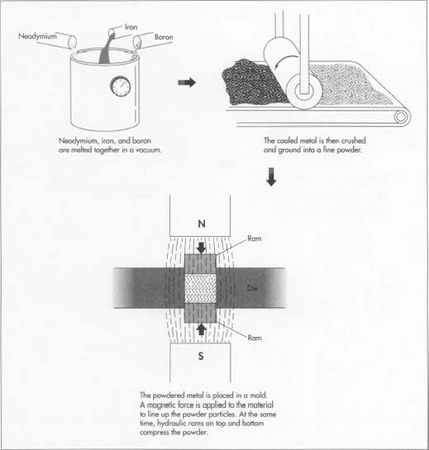
In this process a suitable composition is pulverized into fine powder compacted and heated to cause densification via liquid phase sintering.
Ceramic magnet manufacturing process.
In this article we will focus on the various methods and their respective advantages and drawbacks.
A multiple stage milling operation reduces the calcined material to a small particle size.
Cylindrical parts may be pressed to shape usually axially or core drilled from block stock material.
They are composed of iron oxide and strontium carbonate.
A ferrite is a ceramic material made by mixing and firing large proportions of iron iii oxide fe 2 o 3 rust blended with small proportions of one or more additional metallic elements such as barium manganese nickel and zinc.
Ceramic or ferrite magnets are produced by calcining a mixture of iron oxide and strontium carbonate to form a metallic oxide.
While their hard brittle quality and low energy exclude them from some applications ceramic magnets have won wide acceptance due to their corrosion and demagnetization.
The weighing process need to follow the formula strictly or cannot get the desirable magnetic properties.
There are several processes for making magnets but the most common method is called powder metallurgy.
They are electrically nonconductive meaning that they are insulators and ferrimagnetic meaning they can easily be magnetized or attracted to a magnet.
The raw material of ferrite includes main raw material additives and flux agents.
Fe 2 o 3 baco 3 srco 3 and caco 3 are main raw material of ferrite.
These longer cylinders either solid or with an id can later be sliced to form thin washer shaped magnets.
Home resource magnet manufacturing process.
Sintering rare earths ferrites and alnicos rare earth ferrite and alnico magnets can be manufactured with this method.
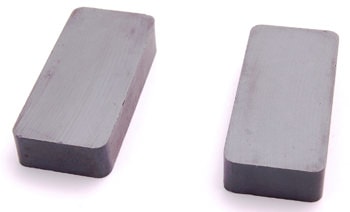
What is a ceramic magnet ceramic magnets also known as ferrite magnets were developed in the 1960 s as a low cost alternative to metallic magnets.
Ferrite magnets can be isotropic or anisotropic.
The materials used in permanent magnets sometimes known as hard materials reflecting the early use of alloy steels for these magnets are different than the materials used in electromagnets some times known as soft materials reflecting the use of.
Magnet manufacturing process there are several processes for making magnets but the most common method is called powder metallurgy.
The ceramic ferrite magnet is made by a powder metallurgy process.
The sintering process involves compacting fine.
Permanent magnets of different materials neodymium smco ferrite alnico flexible have different manufacturing methods.
The anisotropic ferrite magnets have a preferred direction of magnetisation within the structure and have strongest magnetic.